The Fall 2026 Scholarship Application Is Now Open
Advancing music. Enriching lives.
Brothers, the door is open.
As of today, October 14, 2026, the Sinfonia Educational Foundation is accepting applications for the Fall 2026 Scholarship Program: $14,000 in scholarships and grants for undergraduate collegiate Sinfonians, spread across twelve named awards. Every one of them carries the name of a Brother, a chapter, or a family whose life and generosity made the award worth giving.
Since the program began, more than one hundred collegiate Brothers have received direct financial assistance from the Foundation, funded entirely by alumni Sinfonians and friends of the SEF. That is the Object at work in its plainest form: the mutual welfare and brotherhood of musical students, paid forward from one generation of Sinfonians to the next. Tuition does not get cheaper, and the Trustees have made this program a standing priority for a simple reason: keeping a Brother enrolled keeps a musician in the room.
One application covers all twelve awards. Applications are scored, and awards are made in declining order of value: the strongest application receives the largest award, the next receives the next, and so on down the list. The program is for undergraduates. Applicants must be collegiate members in good standing with at least one complete semester of good standing behind them, and must be enrolled full time in an undergraduate degree program for the Spring 2027 term, when the awards are paid.
The application closes at the end of the day on Monday, November 30, 2026 (11:59 pm Central). Recipients will be announced by December 4, and each award is sent to the recipient’s school to be credited to the Spring 2027 term.
“I can think of no other organization that places its members in such a position to make a difference as Sinfonia does.”
Brother Brett C., Lambda Phi Chapter, SEF scholarship recipient
Application Window & Timeline
- Applications open: Wednesday, October 14, 2026
- Deadline: Monday, November 30, 2026, 11:59 pm Central
- Recipients announced: By December 4, 2026
- Awards sent to institutions: Shortly after, credited to the Spring 2027 term
How to Apply
A single online application covers every SEF scholarship and grant, and you can save your progress and come back to it. You will be asked for membership and academic information, a brief account of your Fraternity involvement, musical achievement, and campus and community service, a concise statement of need, and a composite-style coat-and-tie photo. New this year, the application also asks for the contact information of your school’s financial aid or scholarship office, so an award can be credited to your account without delay.
After you submit, your Chapter President and your Faculty Advisor each receive an email asking them to certify your standing. Let them know it is coming; your application is not complete until both have answered.
The Named Awards for 2026
Eight one-time named grants honor Sinfonians whose lives set the standard, and four endowed scholarships are given in perpetuity. Together they match the largest single-semester offering in the history of the program. Each award is described below with the person behind it, because the names are the point: these are the Brothers you are being asked to measure up to.
Named Grants
T. Jervis Underwood Leadership Grant: $2,500
Dr. T. Jervis Underwood (Gamma Theta, North Texas, 1954) led the Fraternity as National President from 1988 to 1991, then kept its memory as National Historian for the decade that followed and wrote A Centennial History. He received the Ossian Everett Mills Award in 1997 and the Robert J. Rogers Lifetime Service Award, and he stands among the most influential leaders Sinfonia has had.
The largest award in the program looks for Brothers who lead the way he did: with integrity, with a chapter culture made stronger by their time in it, and with results in the community that can be seen and counted. The grant is distinct from the Underwood Scholarship Fund, which is still building its endowment and accepting gifts.

Brian M. Stratton Advancement of Music Grant: $1,500
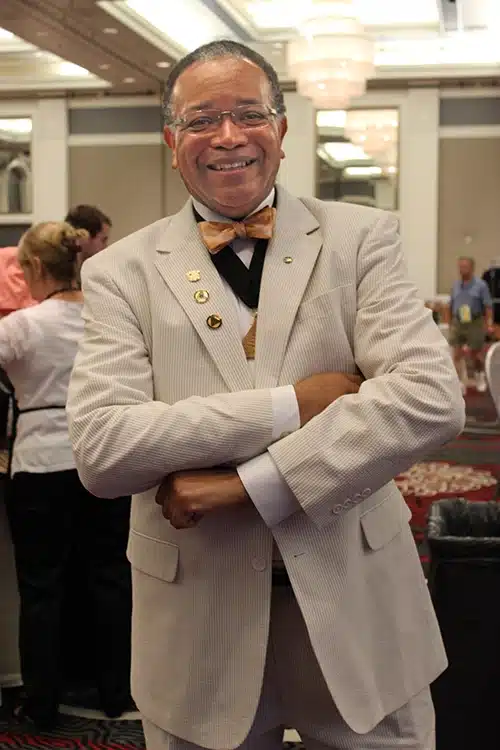
Brother Brian M. Stratton (Delta Omega, Southeastern Louisiana, 1979) was a celebrated lyric tenor who sang at the White House, recorded with the Moses Hogan Chorale and the Mormon Tabernacle Choir, and taught a generation of singers through clinics and workshops. A longtime Province Governor, he became the Fraternity’s first African American member of the National Executive Committee as National Vice President from 1997 to 2000, and was inducted into the National Honorary Alpha Alpha Chapter in 2010. Across the Fraternity he was known simply as “the Godfather.”
This grant supports work that raises the level of choral and vocal artistry: performance, conducting, composition and arranging, recording and production, teaching, and projects that bring singing to people who would not otherwise have it.
Rolland H. Shaw Advancement of Music Grant: $1,500
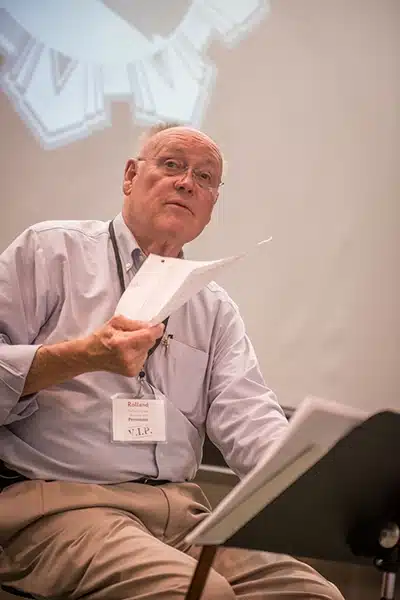
Dr. Rolland H. Shaw was a charter member of Theta Kappa at Mississippi College, a choral pedagogue, and a province and national leader whose six decades of service made him Sinfonia’s “musical conscience.” He conducted the National Assembly and Convention choruses and chaired the revision of the Centennial Songbook.
The Shaw grant is aimed at music education students and chapter music directors: Brothers who lead an ensemble, teach conducting, run sectionals, and prepare repertoire the right way, and who will carry best choral practice into every classroom and chapter room they lead.
Ralph Howard Pendleton Education Grant: $1,000
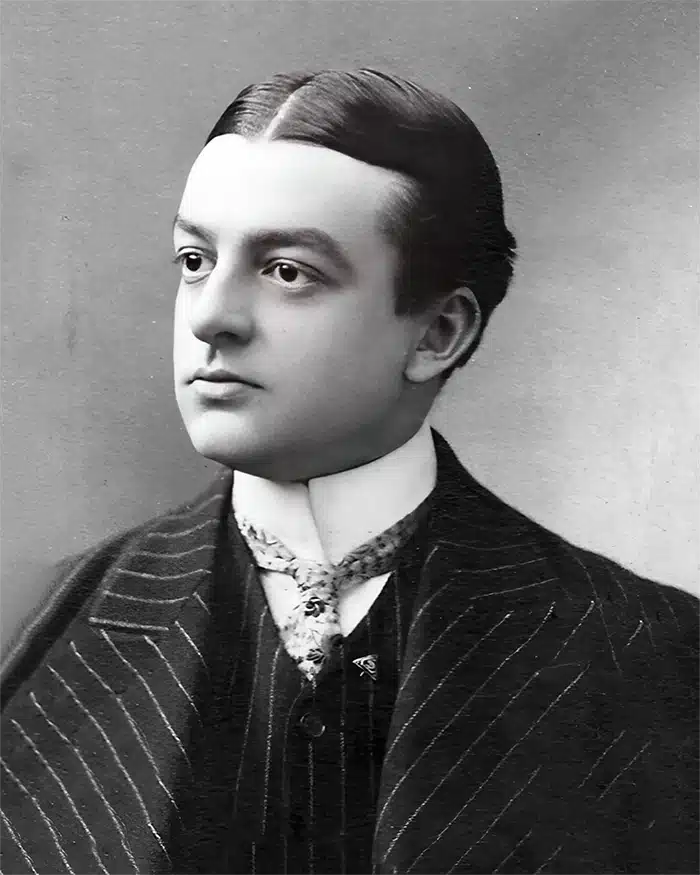
Ralph Howard Pendleton (Alpha, New England Conservatory, 1899) was initiated in the Sinfonia Club’s first class on November 28, 1898, and did more than anyone to turn a Boston club into a national fraternity. He was the first to propose that Sinfonia expand, and on October 6, 1900, he was one of the men from Boston who admitted Beta Chapter in Philadelphia and wired home the words “The Sinfonia now National.” He served as the Fraternity’s first Supreme Secretary, wrote the lyrics of the Sinfonia Parting Song, and gave his personal set of Year Books to form the nucleus of the national archives. Quiet, friendly, and terrified of public speaking, he let others give the speeches and did the work.
“It was needed; there was a place for it; it was born.”
Ralph Howard Pendleton, 1901
This grant is for Brothers advancing education in the Fraternity and beyond it: teaching candidates, chapter historians, and Fraternity Education Officers who strengthen teaching and learning and keep the story of Sinfonia alive for the Brothers who come next.
John C. Schmidt Leadership Grant: $1,000
Dr. John C. Schmidt taught musicology and theory at Texas State University from 1976 to 2021, served thirty years as Faculty Advisor to the Gamma Phi Chapter, and sat three terms as a Trustee of the Sinfonia Educational Foundation, where his good humor and his spirited support of the scholarship program gave the board a continuity it still draws on. A Fellow of the American Guild of Organists and a distinguished scholar of John Knowles Paine, he accompanied the Men of Song Chorus for many years and brought the 57th National Convention in St. Louis to its feet with an organ recital alongside Stuart Corrie.
The Schmidt grant recognizes Brothers who pair academic excellence with practical leadership: tangible results in chapter operations, on campus, and in the community. It rests on Brother Schmidt’s conviction that scholarship and service belong together, and that leadership is proven not by titles but by the students you lift, the chapters you strengthen, and the music you bring to life.
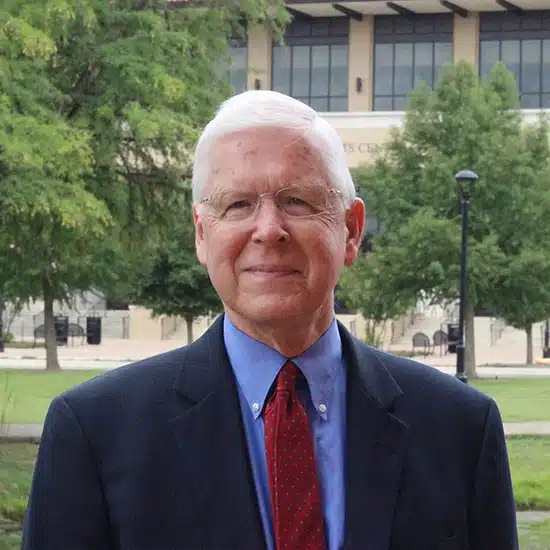

Fred Rogers Leadership Grant: $1,000
Fred Rogers graduated from Rollins College in 1951 with a degree in music composition and spent the rest of his life using music to speak to children and their families. He began in children’s television in 1953 with The Children’s Corner, founded Family Communications in 1971 to produce Mister Rogers’ Neighborhood, was ordained a Presbyterian minister, received honorary degrees from more than forty colleges and universities, and in 2002 was awarded the Presidential Medal of Freedom. He was also a Sinfonian, and the music always came first: he wrote the Neighborhood’s songs himself, hundreds of them, and used them to help children name what they were feeling. He believed that listening is one of the most important things we can do for one another.
New this year, the Rogers grant is for leadership that is quiet, patient, and directed at other people: Brothers who make a chapter a place where younger Brothers are heard, who bring music to audiences no one else is serving, and who understand that the measure of leadership is who it lifts.
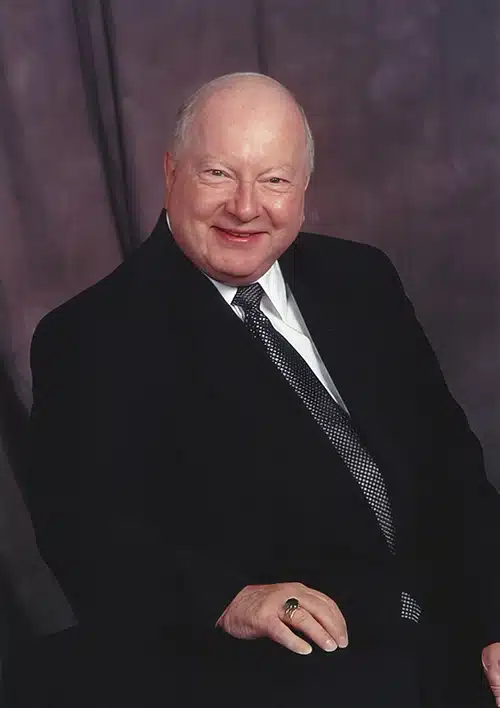
J. Robert Whalin Leadership Grant: $1,000
Dr. J. Robert “Bob” Whalin was a concert pianist and a teacher who began his career at Texas State in 1964 and became one of the School of Music’s steadiest advocates, twice honored by the Faculty Senate with its Award for Excellence in Teaching. He was friend, advisor, and mentor to the Brothers of Gamma Phi for many years, then Governor of Province 9 for twenty-one, and he received the Robert J. Rogers Lifetime Service Award. His smile could light up the darkest room and his laugh was legendary. Brother Whalin passed away on May 9, 2023.
This grant is for Brothers who lead with excellence, kindness, and a steadfast commitment to our ideals.
Ellis Marsalis Musicianship Grant: $1,000
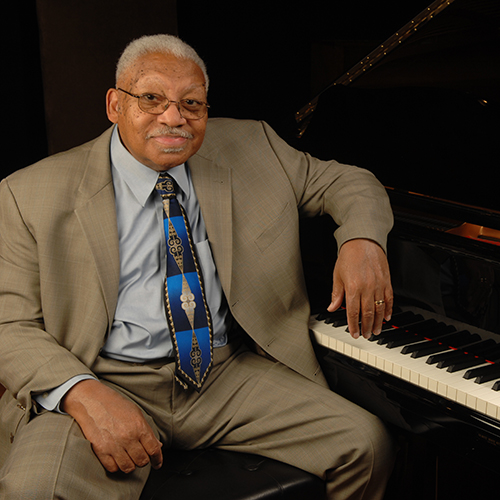
Brother Ellis Marsalis, Jr. (Delta Epsilon, Louisiana at Lafayette, 1965) was the New Orleans pianist and teacher who shaped modern jazz less through his own celebrated playing than through the musicians he taught, training a generation of players at the New Orleans Center for Creative Arts. The Fraternity gave him its National Citation at the 1998 Leadership Conclave, inducted him into the National Honorary Alpha Alpha Chapter in 2015, and at the 55th National Convention in his hometown that same year conferred on him the Charles E. Lutton Man of Music Award, naming him a Signature Sinfonian.
New this year, the Marsalis grant supports Brothers pursuing excellence in musicianship and in the jazz tradition: in performance, in composition and arranging, and above all in teaching, which is where Marsalis made the difference that outlasted him.
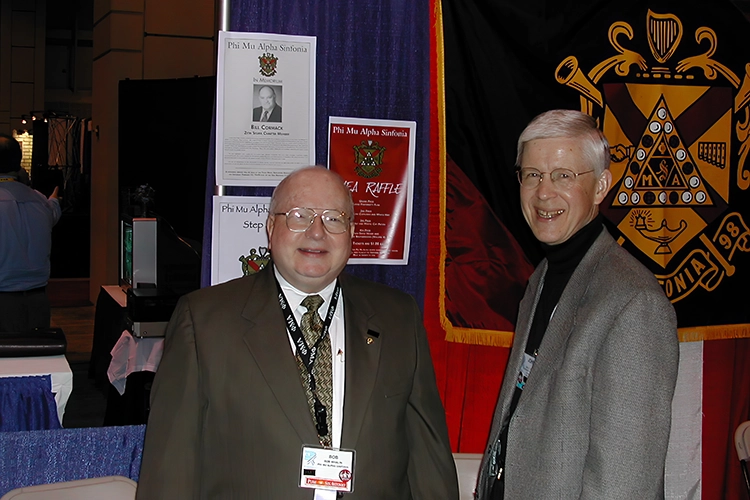
The Schmidt and Whalin grants are funded by the generous gifts of Gamma Phi Chapter alumni at Texas State University, in honor of two servant leaders who directed and sustained the Brothers of Gamma Phi for decades.
Endowed Scholarships
Four named scholarships are permanently endowed and will be awarded every year for as long as there is a Sinfonia. Donors who wish to create one may endow a named scholarship beginning at $25,000, individually or through a group campaign in memory of a Brother who inspired them.
Dr. Philip Autry Memorial Scholarship: $1,000
Dr. Philip E. Autry (Mu Gamma, Angelo State, 1999) was a pianist whose playing was described as “clarity and precision coupled with feeling and emotion,” and a teacher for nearly thirty years, nearly two decades of them at Fisk University, where he served as Professor of Music and chaired the Department of Arts and Languages. He was Faculty Advisor to the Zeta Rho Chapter and Governor of Province 15 for nearly a decade, and the Fraternity named him Province Governor of the Year in 2015. When he passed away on February 20, 2020, he left his retirement funds to the Foundation. That gift became the Autry Memorial Scholarship, fully endowed in 2025.
The scholarship supports Brothers who exemplify excellence, service, and a commitment to musical growth.


W. Eldridge and Emily Lowe Scholarship: $1,000
Brother W. Eldridge Lowe, an initiate of Alpha Chapter, married Emily, a well-known patron of music and the arts in Boston. Both belonged to music and social fraternities, and when they died a portion of their estate went to the organizations they held dear. For twenty-five years the award was paid from the trust’s investment income; when the trust expired, its proceeds came to the beneficiary fraternities, and the Lowe Scholarship became the longest continuing endowed scholarship the SEF offers, now in its third decade.
In keeping with the Lowes’ wishes, the scholarship recognizes academic strength, a strong commitment to Brotherhood and Sinfonia, and a demonstrated understanding of advancing music beyond the local campus.
“Although our brothers cannot necessarily advance music in America financially, I am proud to say that we do our part very effectively through the community we foster together.”
Brother Joel A., Beta Nu Chapter, Lowe Scholarship recipient
Christopher Patterson Memorial Scholarship: $1,000
Brother Christopher Patterson was initiated into the Kappa Sigma Chapter at Valparaiso University in October 2010, a music education student from a strong military family. He enlisted in the Indiana National Guard and served as a combat engineer with the 713th Engineering Company out of the Valparaiso Armory. When his unit was activated he did not have to go; he chose to. He lost his life in January 2012 on active duty in Kandahar Province, Afghanistan. The scholarship was established by the Kappa Sigma Chapter and Brother Kevin Goebbert to honor his life and service.
It supports Brothers who reflect Brother Patterson’s dedication to music, Brotherhood, leadership, and service to his country.
“The bonds that we create as brothers are necessary for our work to truly uplift mankind. As brothers, we have all felt that indescribable sensation when moved by music. To be able to share that with one another is what allows us to share that with everyone around us.”
Brother Connor S., Nu Pi Chapter, Patterson Memorial Scholarship recipient


Delta Iota Alumni Scholarship: $500
The Brothers of Delta Iota at Western Michigan University in Kalamazoo have been advocates and supporters of the Foundation for going on five decades, and the chapter has provided annual support throughout. Its alumni were the first such group to fund an annual scholarship, and in the Delta Iota habit of looking past their own chapter walls, they did not restrict it to their own: the Delta Iota Alumni Scholarship is open to every undergraduate member of the Fraternity.
“Brotherhood provided me the fuel to take that step forward and find harmony within myself, and because of that, I was able to spread this newfound fraternal spirit to others through music.”
Brother Brantley W., Epsilon Iota Chapter, Delta Iota Alumni Scholarship recipient
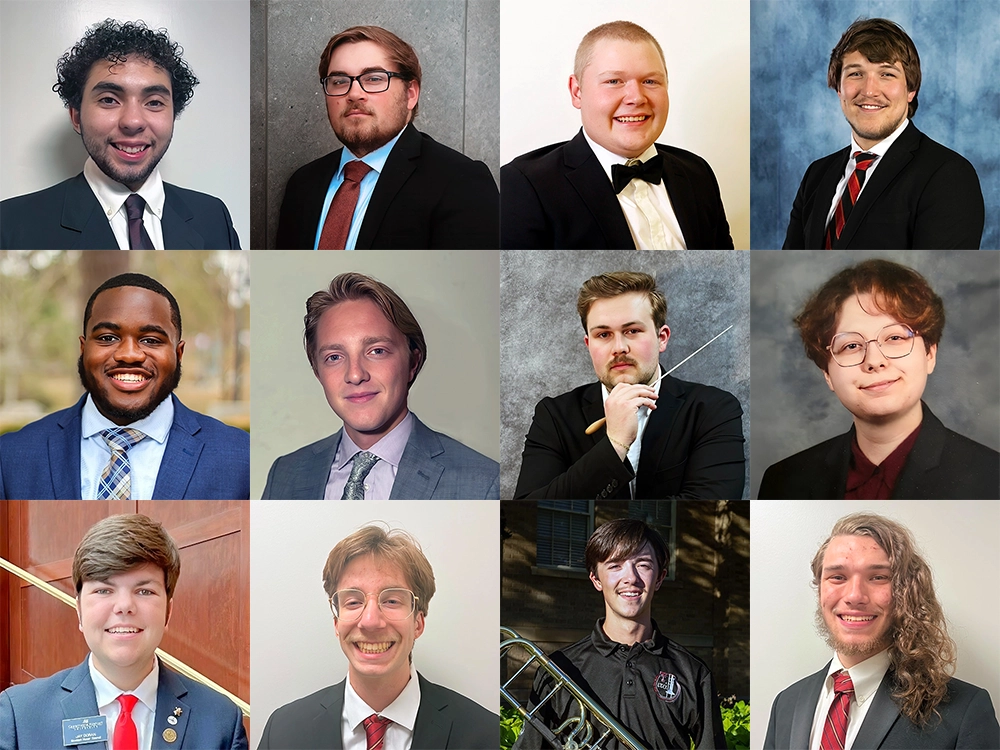
Where Last Year’s Awards Went
Last December, twelve Brothers received the Fall 2025 awards: among them a trumpet player who coordinates a 350-member marching band, a chapter president who held his chapter together through a suspension and brought it back, a computer science major who directs his chapter’s music, and an arranger and chaplain of the Marching 100. They were chosen from an exceptionally strong pool, and the pool is the point: the more Brothers who apply, the more the Foundation learns about what Sinfonians are doing on their campuses, and the better the case it can make to the donors who fund the next round.
A Note for Donors:
Eight of this year’s twelve awards are one-time grants, offered as a pilot to see what named awards do for applicant engagement and donor visibility. They are not guaranteed in future years. The way to make a name permanent is an endowment: a named scholarship may be endowed beginning at $25,000, individually or through a collective campaign, and is then given every year in perpetuity. To discuss an endowment or targeted program support, please contact [email protected].
“Let it be our ambition to make the Sinfonia a power for good, and have faith to believe that in future years its beneficent influence will be felt around the globe.”
Ossian Everett Mills
Every award on this page is that ambition, kept. Apply, Brothers, and tell a Brother who should. Hail Sinfonia!

Empowering Musicians
Receive Updates on New Scholarships, Grants, and Awards!
When you subscribe, you give us permission to send you emails about SEF scholarship & grant opportunities and updates. You have the option to withdraw your consent at any point by clicking on the unsubscribe link provided in each email. We send maximum a couple of emails per month—no spam, ever.