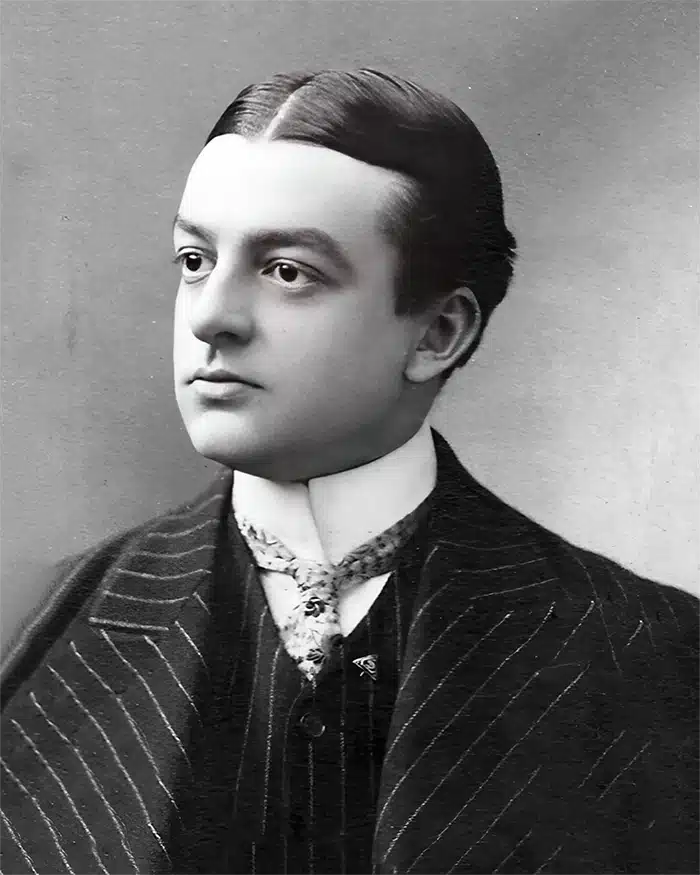
Ralph Howard Pendleton (1877-1951)
The Quiet Force
As we celebrate Founder’s Day, and pay homage to the influence and example of Ossian Everett Mills, we are called to reflect on the history and progress of our beloved Sinfonia.
When the Sinfonia Educational Foundation began to explore the notion of offering named grants to honor someone who has made significant contributions to the development of Phi Mu Alpha Sinfonia Fraternity and to support and emphasize the qualities that made the honoree important, Ralph Howard Pendleton immediately came to the forefront.
As is often the case, those who toil quietly behind the scenes and do not seek fame or glory are easily overlooked and lost to history. Brother Pendleton was such a man. He was quiet and friendly, but was terrified by public speaking. His writings, however, would come to define and document the birth of Sinfonia. His dedication to teaching the history of Sinfonia, and encouraging all Brothers to learn and master that history so that it could be handed down to future generations, fueled the growth and success of our Order.
While Father Mills served as the soul of The Object, and Percy Jewett Burrell served as its voice, Ralph Howard Pendleton, as much and perhaps more than any other Sinfonian, served as its hands, strong back, persistent stride and enduring stamina. While Mills and Burrell are well-known names, Brother Pendleton does not often share that distinction.
Initiated with ten other men into the Sinfonia Club as its first class, on November 28,1898, Pendleton was destined to play a key role in the Club’s evolution into the vibrant national organization we know today.
Did you know...
-
Lite Your Pipe
That Brother Pendleton composed the very first Sinfonia song, “Light Your Pipe,” that combined original words and music solely for that purpose, first mentioned in the minutes of the Alpha chapter on February 24, 1902
-
Time for our parting now has come...
That Brother Pendleton composed the lyrics to the “Sinfonia Parting Song “ that is taught to every member and still in use today?
-
Securing Our Legacy
That Brother Pendleton, then secretary of the Alpha chapter, would serve as secretary of the First Convention, and provide us with the details of the acts of that Convention?
-
The Old Boys
That Ralph Howard Pendleton is acknowledged as the very first person to suggest that the Sinfonia Club should become a national organization?
-
Our History
That Brother Pendleton’s personal hardbound collection of every published Sinfonia Year Book was donated to the Fraternity to form the nucleus of our first national archives?
Without Ralph Howard Pendleton and his many selfless contributions, Sinfonia would quite conceivably not exist as we know it today. He is justly worthy of our honor, Brothers, and an example to all who follow us.
The earliest account of the beginning of the Sinfonia was written by Ralph Howard Pendleton, based in part on his “Secretary’s Annual Report,” issued February 26, 1900, which would be published in the inaugural edition of the Sinfonia Year Book in 1901. Pendleton impressed the delegates in Boston sufficiently that he was elected the first Supreme Secretary of the Sinfonia Fraternity for 1901-1902.
Brother Pendleton had a formative role in the first decade of our existence, serving a second term as Supreme Secretary from 1902-1903. He would later serve as Supreme Historian for two terms in 1903-1904 and 1904-1905, and as Supreme Vice President for two terms from 1905-1906 and 1906-1907.
Brother Pendleton would relocate to Philadelphia in 1904 to become a music teacher. True to the Object, he would extend the hand of Brotherhood on his arrival, and joined the Beta chapter.
When the Fraternity sought to bolster the participation of alumni members, and formed the Alumni Loyalty Committee in 1916, Ralph Howard Pendleton was appointed to the committee. Brother Pendleton would become a resource for Sinfonia’s history, and a persuasive advocate for its study and preservation. He would remain active in Fraternity affairs for the rest of his life.
“The history of the Sinfonia is an interesting one. For a better understanding of it the reader must go back to the pre-Sinfonia era, and realize fully that it was an organization rising out of natural causes and conditions. It came to be because there was a need for just such a club. It was not the idea of one or two men, but of many men, and rather than being forced into being, it created itself. It was needed; there was a place for it; it was born.”
– Ralph Howard Pendleton, 1901
Brother Pendleton’s modesty would not allow him to take credit justly deserved, and he never sought it. He was good friends with an Elocution student at the New England Conservatory who would later join the Sinfonia Club, named Percy Jewett Burrell. Pendleton was a tireless and ardent advocate for expansion one on one, but was uncomfortable speaking in front of larger groups. Pendleton would propose the cause for expansion, and Percy Jewett Burrell would give it a persuasive voice.
The members of the Sinfonia Club were not united in support of expansion. A meeting was called on October 1, 1900, to discuss the issue. Everyone knew it would be a contentious discussion. There is a humorous story in the Year Book of Burrell being late to that meeting, throwing Pendleton into an absolute panic that he would not be able to carry the argument. The meeting was heated, and tempers flared. In the end, those for expansion narrowly carried the day.
The majority voted to spend $25.00 from the club’s $34.00 treasury to send men to New York, Philadelphia and Washington to present the idea of a national Sinfonia to male students of the leading conservatories.
On October 6, 1900, the men of the Broad Street Conservatory in Philadelphia requested and received admission to Sinfonia as its Beta Chapter. The men who were empowered to grant admission in the delegation from Boston were Henry Hall…and Ralph Howard Pendleton, who sent a telegram back to Boston with the news, which concluded “The Sinfonia now National.”
The persuasive advocacy of Ralph Howard Pendleton would bring the dream of a larger, National Sinfonia into being.
Brother Pendleton lived the Object in every way, and was always willing to contribute to the betterment of our Fraternity and serve in any capacity necessary to further the Sinfonia. The Ralph Howard Pendleton Education Grant is designed to encourage Fraternity educators and historians to teach Pendleton’s legacy to the Brothers of today, and to further the standard of servant leadership Pendleton represents. So let it be for the Sinfonia!

"the Sinfonia now National"